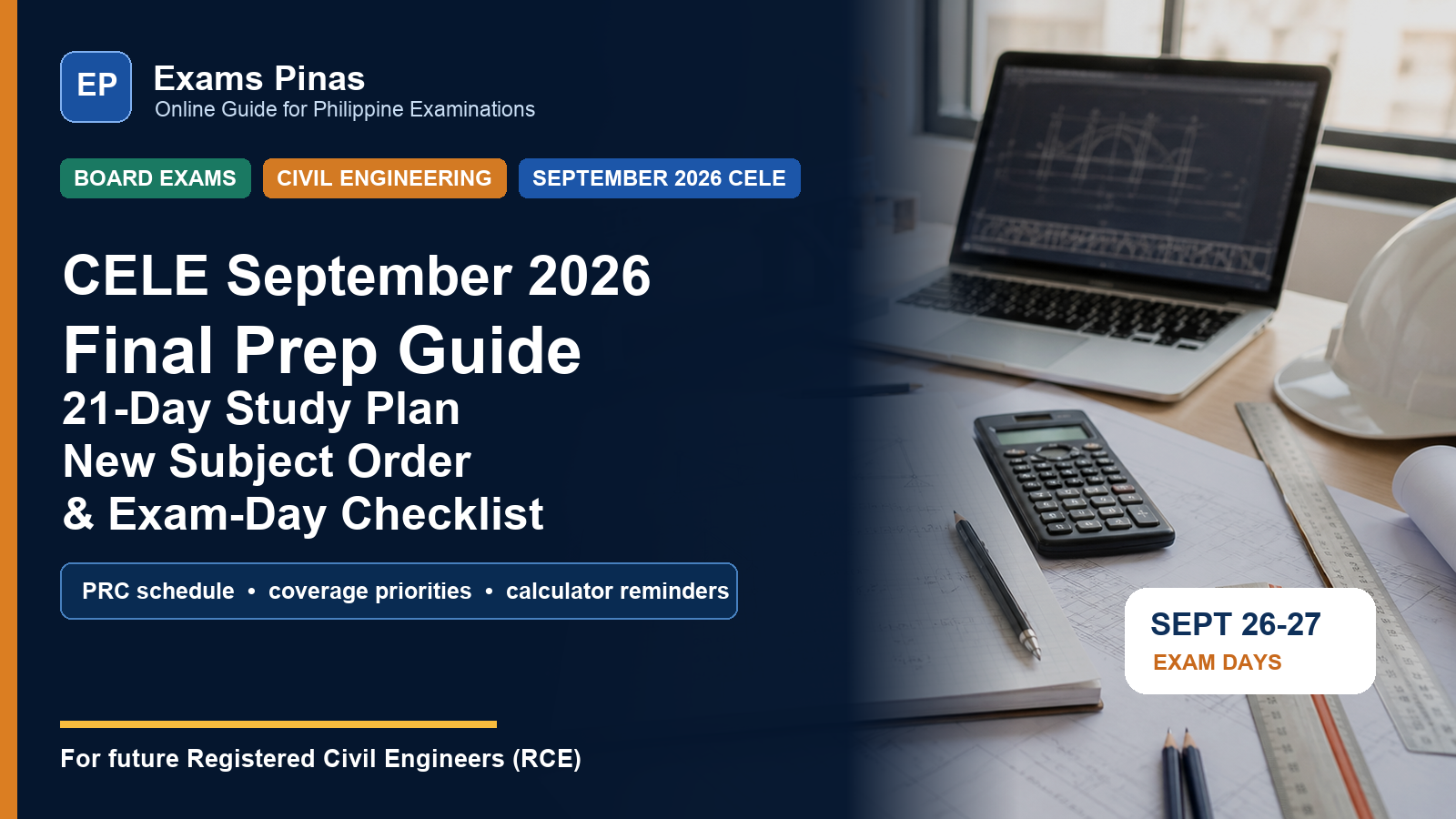

EXAM ALERT: The September 2026 Civil Engineers Licensure Examination (CELE) is scheduled for September 26 and 27, 2026, based on the Professional Regulation Commission’s 2026 schedule. The filing period ran from June 11 to August 12, 2026, and the target release of results is October 2, 2026.
With 21 days left before the September 2026 CELE, the goal is no longer to read everything. The goal is to turn your remaining review time into board-exam points: solve more problems, correct recurring mistakes, memorize only the formulas that matter, and protect your calculator speed and accuracy.
CELE September 2026 Schedule
- Exam dates: September 26 and 27, 2026, Saturday and Sunday
- Application period: June 11 to August 12, 2026
- Target release of results: October 2, 2026
- Administering agency: Professional Regulation Commission (PRC) and Board of Civil Engineering
- Testing centers: NCR, Baguio, Butuan, Cagayan de Oro, Calapan, Cebu, Davao, Iloilo, Koronadal, Legazpi, Lucena, Pagadian, Palawan, Pampanga, Rosales, Tacloban, Tuguegarao, Zamboanga, and Ilocos Sur
Always check the final PRC room assignment, program of examination, calculator advisories, and allowed items before exam day. Testing-center rules and reporting instructions should be followed exactly.
New CELE Subject Order Starting 2026
PRC announced an adjusted CELE subject order beginning with the March 2026 Civil Engineers Licensure Examination. Under that order, examinees take Principles of Structural Analysis and Design on the first day. On the second day, examinees take Applied Mathematics, Surveying, Principles of Transportation and Highway Engineering, Construction Management and Methods, followed by Hydraulics and Principles of Geotechnical Engineering.
This matters for final review. Your first exam day is structurally heavy, so your final three weeks should not bury structural analysis and design under random mixed drills. You need enough daily structural practice to enter Day 1 warm, accurate, and calm.
CELE Coverage: What to Prioritize
Principles of Structural Analysis and Design
- Loads, reactions, shear, moment, and deflection
- Trusses, frames, influence lines, and indeterminate structures
- Reinforced concrete design fundamentals
- Steel and timber design concepts
- Design assumptions, code-style reasoning, and safety factors
Applied Mathematics, Surveying, Transportation, and Construction
- Algebra, calculus, statistics, and engineering economy basics
- Plane surveying, leveling, traverses, areas, and volumes
- Highway alignment, traffic flow, pavement concepts, and transportation planning
- Construction methods, scheduling, estimating, and project management
Hydraulics and Geotechnical Engineering
- Fluid properties, hydrostatics, flow in pipes, and open-channel flow
- Pumps, water resources, and basic hydraulic structures
- Soil classification, compaction, permeability, seepage, consolidation, and shear strength
- Bearing capacity, earth pressure, retaining structures, and foundation concepts
21-Day Final Study Plan
Days 21 to 16: Diagnose Your Weakest Scoring Areas
- Take one timed structural set and one timed mixed set.
- Record errors by topic, not by page number or reviewer source.
- Separate mistakes into concept gaps, formula recall, calculator errors, and time-pressure errors.
- Rework missed problems until you can solve them without looking at the solution.
Days 15 to 10: Structural Analysis and Design Focus
Because Structural Analysis and Design comes first in the adjusted subject order, do not leave it cold. Spend these days on high-frequency structural problem types and design logic. Practice reading the givens carefully, drawing clean free-body diagrams, and checking whether your answer has the correct units and realistic magnitude.
Days 9 to 6: Mathematics, Surveying, Transportation, and Construction
This cluster rewards organized formulas and speed. Build a short formula sheet from memory, then compare it with your reviewer. Do not copy every formula. Keep the ones you actually use, the ones you keep forgetting, and the ones that connect multiple problem types.
Days 5 to 3: Hydraulics and Geotechnical Lock-In
Hydraulics and geotechnical questions can be unforgiving because one wrong assumption changes the whole solution path. Practice identifying whether the problem is asking for pressure, discharge, head loss, slope stability, consolidation, bearing capacity, or earth pressure before punching numbers into the calculator.
Days 2 to 1: Light Review and Exam Logistics
- Review your error log, formula list, and calculator shortcuts.
- Prepare your Notice of Admission, valid ID, black pens, pencils, envelopes, and allowed calculator.
- Check your room assignment, route, travel time, and weather.
- Sleep early. Tired examinees make avoidable arithmetic and calculator-entry mistakes.
Calculator and Formula Reminders
Use only a PRC-allowed non-programmable calculator. Before the exam, practice with the exact calculator you will bring. Make sure you know how to reset it, switch modes, work with fractions or decimals, use memory functions if allowed, and detect accidental degree/radian or notation mistakes.
- Write units in your scratch solution so you can catch impossible answers.
- Round only at the final step unless the problem clearly requires otherwise.
- Estimate first, compute second. A quick estimate can expose misplaced decimals.
- Do not depend on solution-pattern memory alone. Understand why each formula applies.
Exam-Day Checklist
- Printed PRC Notice of Admission or required exam document
- Valid ID and other required documents
- Black ballpoint pens, pencils, eraser, and sharpener if allowed
- PRC-allowed non-programmable calculator
- Long brown envelope and transparent/plastic envelope if instructed
- Water, simple snacks, and personal medicine if needed
- No review notes, programmable devices, smartwatch, or phone use inside the exam room
Final Advice
The final 21 days before the September 2026 CELE should be active, timed, and honest. Solve problems. Check your errors. Repeat the weak topics. Rest enough to think clearly. Civil engineering boards reward examinees who can stay accurate under pressure, not just those who collected the most reviewers.
Use the remaining days like an engineer: identify the load, choose the method, check the result, and move with discipline.