
Correction (November 10, 2026): This guide originally said the REE would be held on August 29–30, 2026. That was wrong. The 2026 exams were on April 21–22 and September 5–6 (PRC Resolution No. 2113). We also corrected the subject weights to match RA 7920. For the next exams, see our Electrical Engineering Board Exam 2027 guide.
The Registered Electrical Engineer (REE) Licensure Examination is given by the PRC through the Board of Electrical Engineering, usually twice a year. The next exams are expected around April and September 2027. The REE grants the right to design, install, and sign and seal electrical plans for buildings, transmission and distribution systems, industrial facilities, power plants, and renewable energy projects across the Philippines. This guide covers the three subject groups, a focused 11-week study plan you can start at any time, recommended reviewers, and test-taking strategies.
Understanding the REE Examination
The Registered Electrical Engineer Licensure Examination is administered by the PRC Board of Electrical Engineering under Republic Act No. 7920 (The New Electrical Engineering Law). Passing the REE grants the title of Registered Electrical Engineer (REE), which is required for signing and sealing electrical designs, supervising installations covered by the Philippine Electrical Code, and signing electrical plans for building permits, factory operations, transmission and distribution facilities, and renewable energy projects.
To pass, you must achieve a general weighted average of 70%, with no grade below 50% in any subject. In 2026, the passing rate was 57.49% in April and 49.31% in September.
The Board of Electrical Engineering also administers the Registered Master Electrician (RME) examination (a sub-professional credential, not to be confused with the Registered Mechanical Engineer of the same acronym) and the Professional Electrical Engineer (PEE) examination (a higher credential requiring four years of post-licensure practice). This guide focuses on the entry-level REE.
The Three REE Subjects (with Weights)
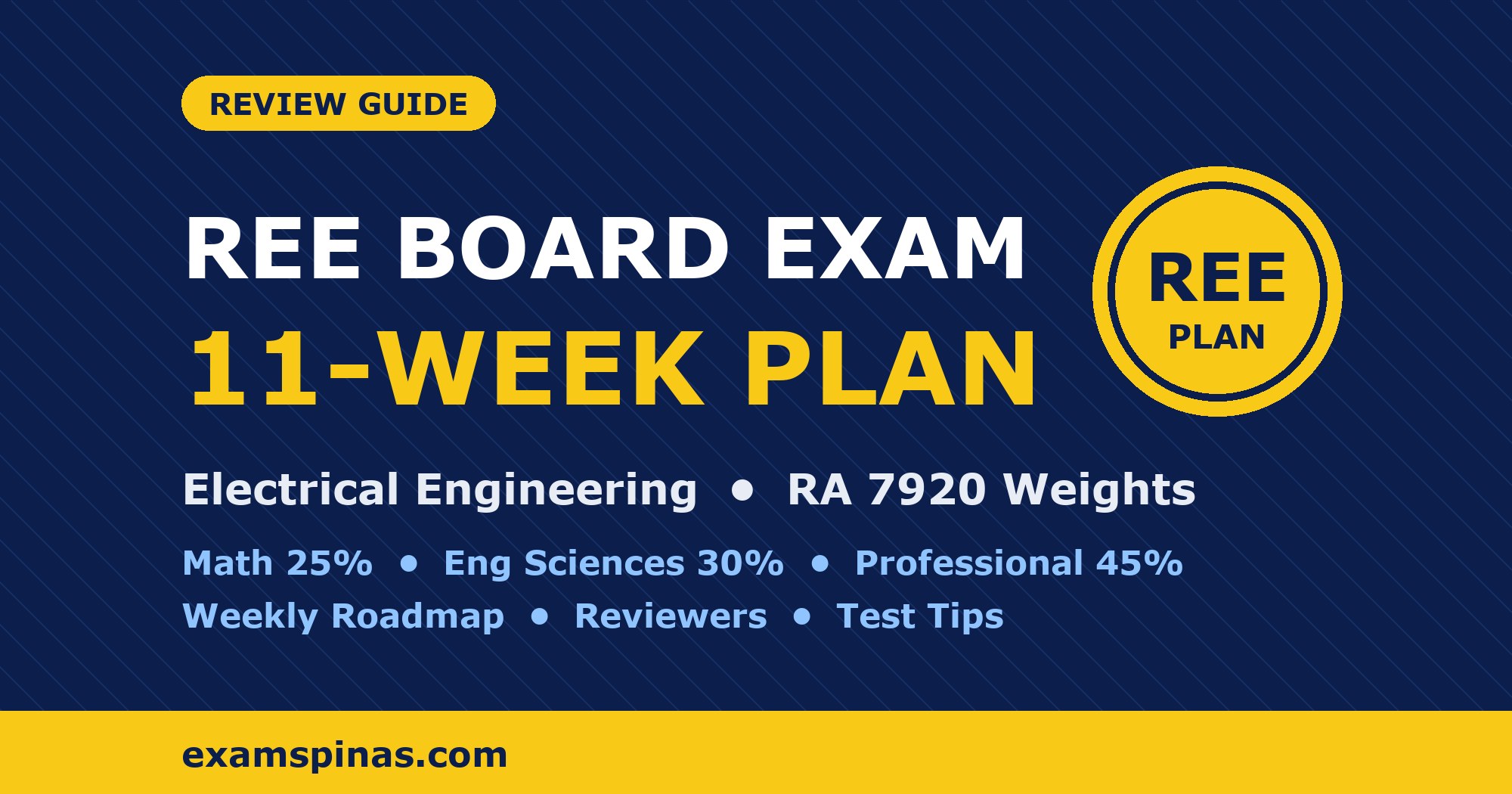
The exam runs over two days. Under RA 7920, it covers three subject groups with these weights:
- Mathematics (25%): algebra, plane and spherical trigonometry, analytic and solid geometry, differential and integral calculus, differential equations, advanced engineering mathematics, statistics and probability.
- Engineering Sciences and Allied Subjects (30%): engineering economy, engineering management, contracts, R.A. 7920 and the Code of Ethics for Electrical Engineers, physics, chemistry, statics, dynamics, strength of materials.
- Electrical Engineering Professional Subjects (45%): DC and AC circuits, electromagnetic theory, transformers, DC and AC machines, power generation, transmission and distribution, electronics, instrumentation, the Philippine Electrical Code (PEC), illumination, power plant engineering, protective devices, power system analysis, control systems and energy management.
Professional Subjects carry the heaviest weight at 45%, nearly half your rating. Strong preparation there is the most reliable path to a passing average.
Your 11-Week Study Roadmap
Weeks 1–2: Diagnostic and Mathematics
Take a full-length mock REE in your first week to identify your weakest subject. Then dedicate two weeks to Mathematics and Engineering Economy — recurring tools across all three subject groups. Drill algebra, trigonometry, calculus (especially differential and integral), differential equations, complex numbers, vectors, and basic probability. For Engineering Economy, master present worth, annual worth, rate of return, payback period, and depreciation methods. Target 30 items per day.
Weeks 3–4: Engineering Sciences and Allied Subjects
Master the foundational sciences: Physics (mechanics, thermodynamics, optics, modern physics), Statics and Dynamics, Strength of Materials (stress, strain, beams), and Chemistry fundamentals. Also cover Engineering Management, Contracts, and most importantly R.A. 7920 and the Code of Ethics for Electrical Engineers — ethics and law items appear in every batch and are worth easy points. Target 30 items per day.
Weeks 5–7: AC/DC Circuits and Machines
Spend three weeks on the circuits and machines part of the Professional Subjects. Master DC circuit analysis (Kirchhoff’s laws, mesh and nodal analysis, network theorems), AC single-phase and three-phase analysis (phasors, complex impedance, power triangle), transformers (single-phase and three-phase, per-unit system), DC machines (generators and motors, characteristics), AC machines (synchronous generators and motors, induction motors, single-phase motors), and the basics of transmission and distribution (line parameters, voltage regulation). Target 40 items per day with case-based reasoning.
Weeks 8–10: Apparatus, Devices, and the Philippine Electrical Code
Spend three weeks on apparatus, the Code and power systems, the rest of the Professional Subjects. The Philippine Electrical Code (PEC 2017 or latest) is mandatory reading — especially Part 1 (Wiring and Protection, Wiring Methods and Materials, Equipment for General Use, Special Occupancies and Equipment) and Part 2 (Underground and Overhead Lines). Master illumination engineering (lumen method, point-by-point method, lamp characteristics), power plant engineering (Rankine cycle for steam plants, hydroelectric basics, solar PV systems, wind energy), protective devices (relays, fuses, circuit breakers, surge arresters), and basic power system analysis (symmetrical components, short circuit analysis, load flow). Target 40 items per day.
Week 11: Full Mocks and Code Review
Take two full-length mock REEs (one on each of the final two weekends) under timed 5-hour-per-subject conditions. Review every wrong answer with the underlying formula or theory. The final week is for the Philippine Electrical Code (PEC 2017 or latest), the Code of Ethics for Electrical Engineers, R.A. 7920 and its IRR, the National Building Code (P.D. 1096) provisions on electrical works, and selected DOE Energy Efficiency standards. Stop learning new content the week before the exam.
Recommended Reviewers and References
- Excel Review Center REE Reviewer — the long-standing Filipino gold standard for REE preparation, with comprehensive coverage across all three subjects and full mock exams.
- Pinoybix Engineering REE Reviewer — large online question bank with explanations, popular with self-reviewers.
- Padilla Electrical Engineering Reviewer — classical Filipino reference with worked solutions.
- Siskind Direct-Current and Alternating-Current Machinery — standard reference for machines.
- Wildi Electrical Machines, Drives, and Power Systems — modern alternative covering machines and power systems in depth.
- Glover Power System Analysis & Design — for power system topics.
- Philippine Electrical Code (PEC 2017 or latest edition, IIEE) — mandatory reading. Many PEC-based items are tested verbatim.
- R.A. 7920 (New Electrical Engineering Law) and its IRR — ethics and practice questions are often verbatim.
- National Building Code (P.D. 1096) — for electrical works provisions.
Top Test-Taking Strategies for the REE
- Answer easy items first. With 100 items in 5 hours per subject, you have 3 minutes per item. Don’t lose more than 5 minutes on any one problem in the first pass.
- Estimate before computing. Many REE answer choices are an order of magnitude apart — a rough estimate eliminates impossible options instantly.
- Draw the circuit diagram. Always. Even simple circuit problems are easier when you sketch the network and label currents, voltages, and impedances.
- Use the per-unit system for power problems. It dramatically simplifies multi-voltage transformer and transmission problems.
- Bring at least two calculators. Battery dies happen. The PRC permits non-programmable, non-printing calculators only — Casio FX-991 series is the gold standard for complex number arithmetic.
- Memorize the PEC tables format. You will need to know typical ampacities, conductor sizes, conduit fill, and overcurrent protection ratings from Part 1.
- Never leave a blank. There is no penalty for wrong answers. Always shade something — a blind guess gives you a 25% chance.
Exam-Day Checklist
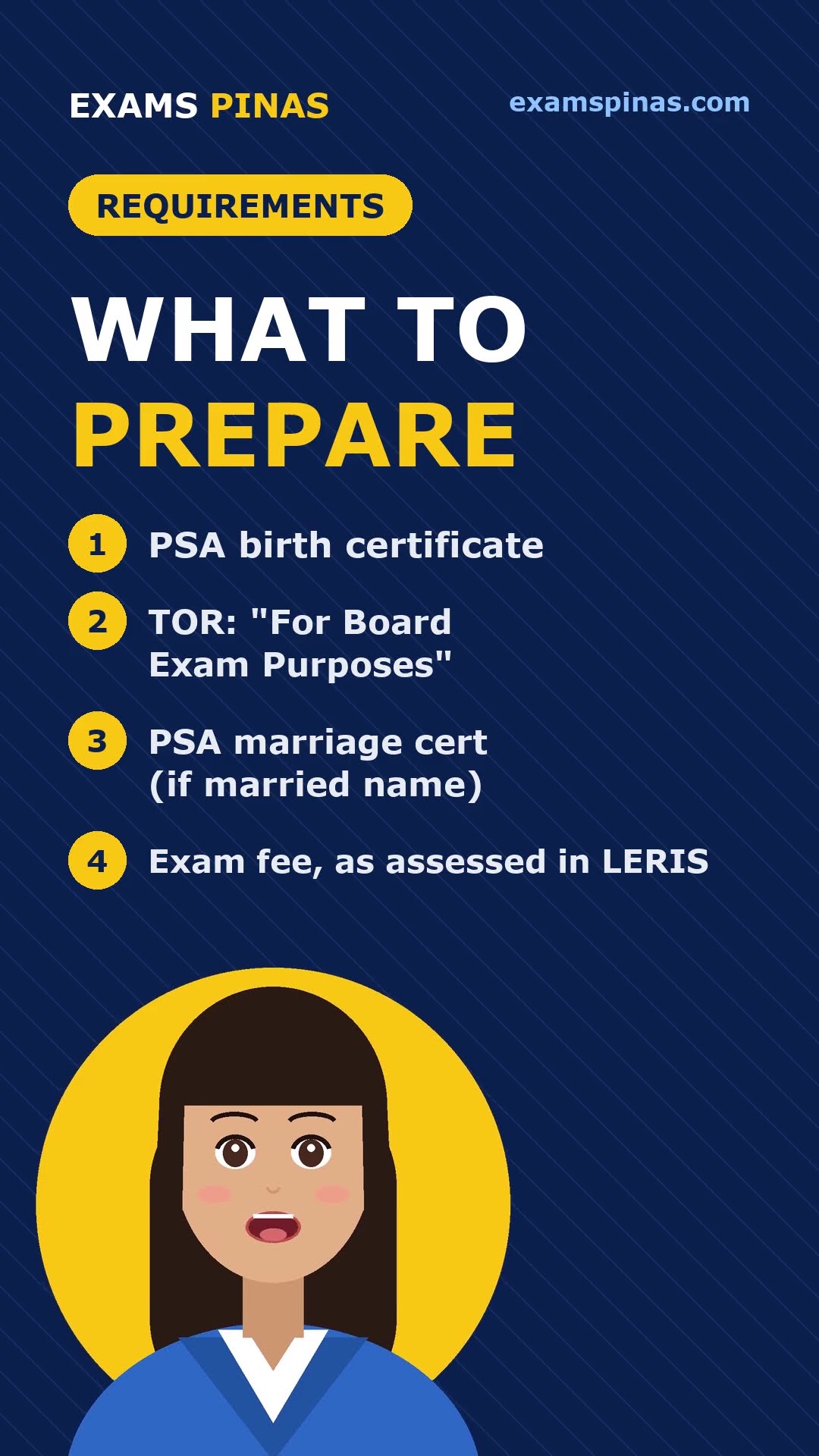
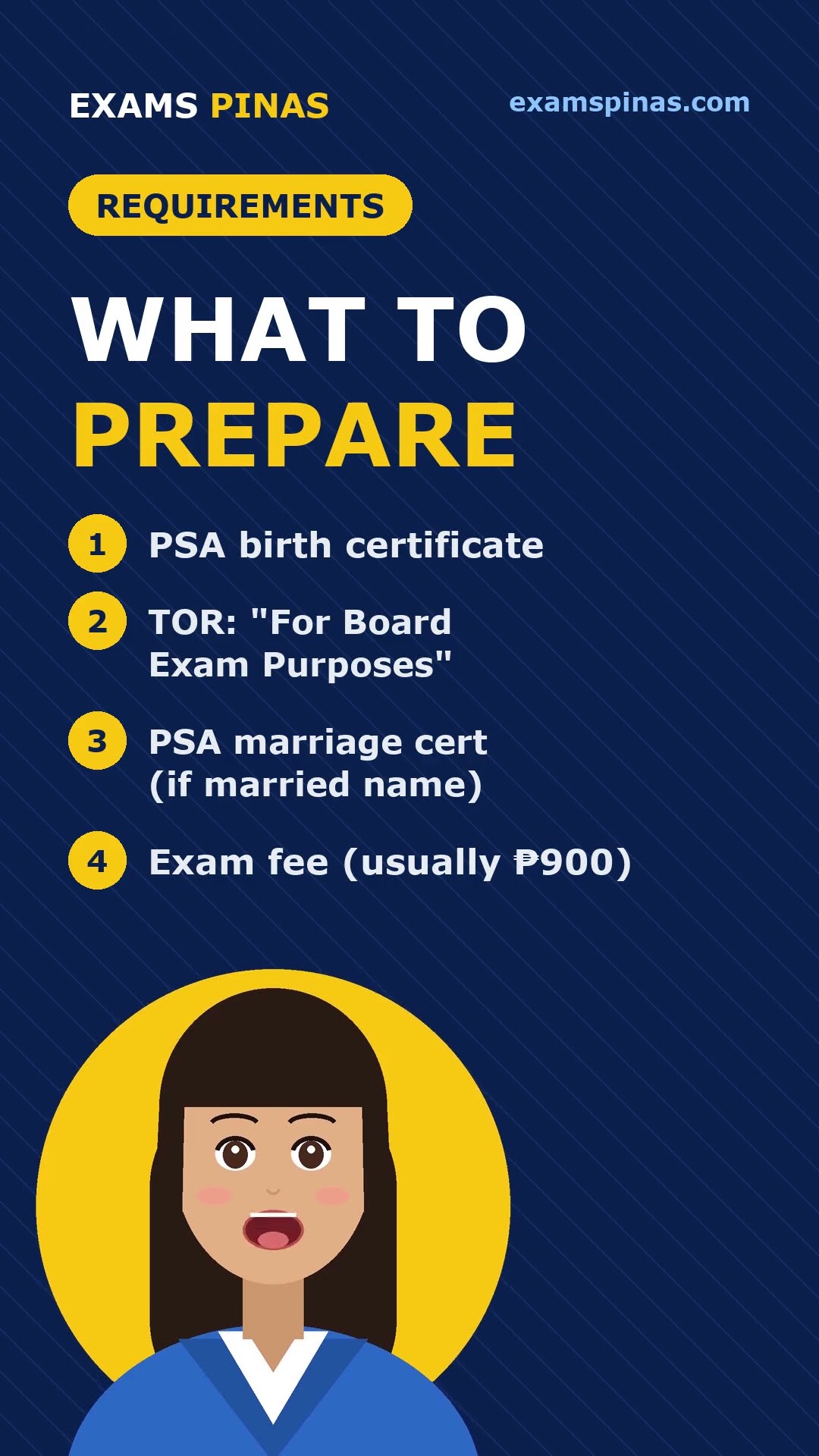
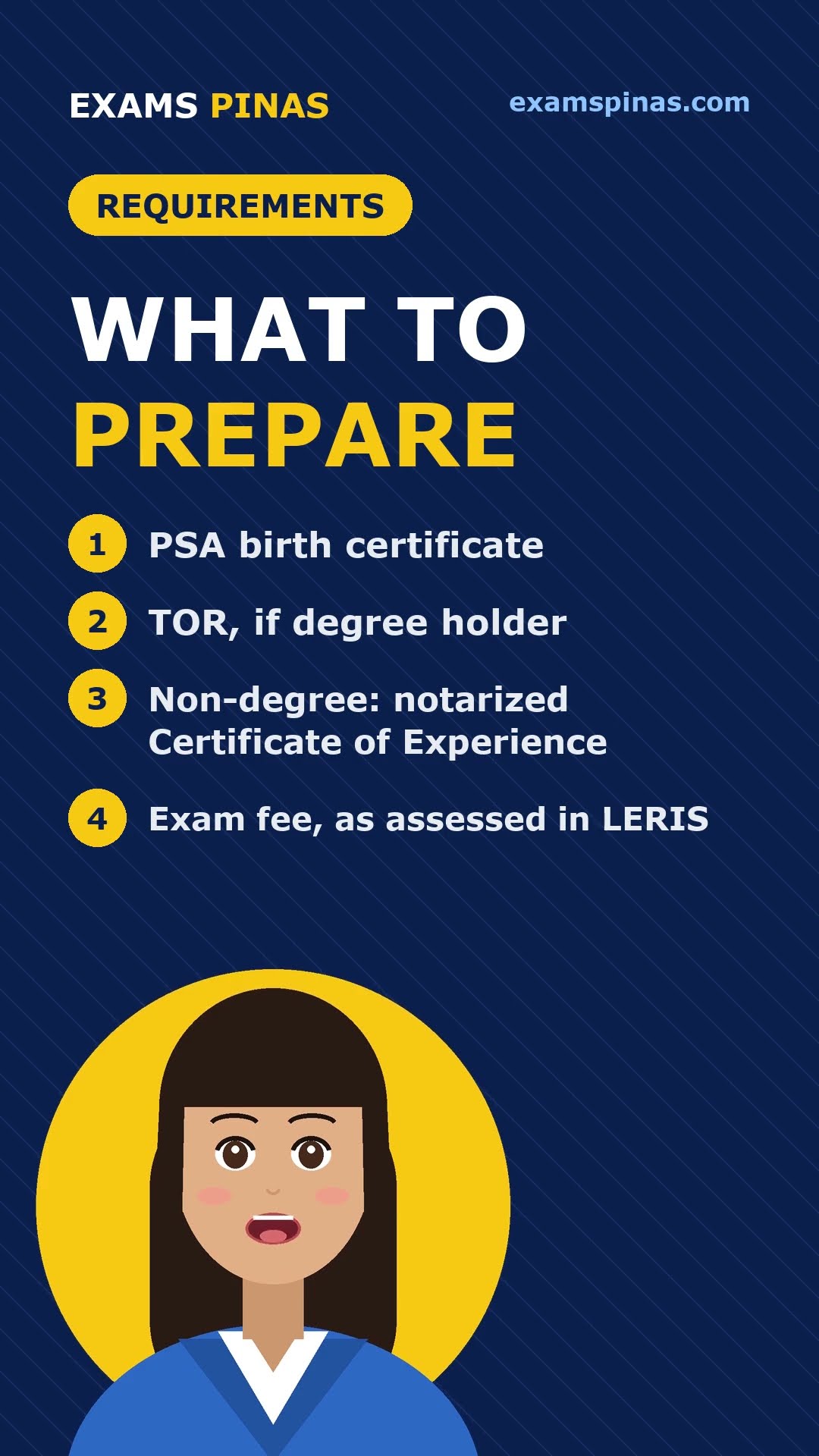
- Notice of Admission (NoA), printed for each day
- Original PRC-recognized ID with photo and signature
- Two or more non-programmable scientific calculators (Casio FX-991, Sharp EL-W516, or equivalent with complex number support)
- Spare batteries for your calculator
- At least two black ballpoint pens (no erasable ink)
- Several No. 2 pencils with eraser for scratch work
- Long brown window envelope (PRC requirement)
- Transparent water bottle and high-protein snacks (5-hour subjects demand sustained focus)
- Analog watch (no smartwatches inside the testing room)
- Decent shoes and a jacket (testing rooms are heavily air-conditioned)
Arrive at the testing center by 6:30 AM. Visit the venue the day before if possible — weekend morning traffic and parking around major PRC testing centers can wreck your nerves.
Common Mistakes That Cost Eligibility
- Bringing a programmable calculator (instant confiscation and disqualification).
- Underestimating Engineering Economy — it consistently appears and is worth easy points if mastered.
- Skipping the Philippine Electrical Code — PEC-based items appear throughout the Professional Subjects and are often verbatim from the code.
- Confusing per-phase vs per-line quantities in three-phase calculations (voltage, current, power).
- Forgetting power factor sign conventions (leading vs lagging) and the resulting reactive power direction.
- Cramming the night before instead of resting — 5 hours of computation per subject demands stamina.
After the Exam
PRC usually releases REE results within about a week. The April 2026 results came out on April 28, and the September 2026 results on September 14. Passers should monitor the PRC LERIS portal for their registration appointment and the schedule of the mass oath-taking ceremony. Once registered as a Registered Electrical Engineer (REE), you can sign and seal electrical designs, pursue specialized practice in power systems, renewable energy, building electrical design, industrial automation, or substation engineering, and apply for senior positions in private firms, government agencies (DOE, ERC, NGCP, Meralco, NEA, electric cooperatives), and the construction sector.
The IIEE (Institute of Integrated Electrical Engineers of the Philippines) is the official accredited professional organization — joining unlocks Continuing Professional Development (CPD) units required for license renewal every three years and connects you to the broader Filipino electrical engineering community.
A Final Word for Future REEs
The REE is rigorous because electrical engineering powers almost every productive sector of the Philippine economy — from the transmission grid that delivers electricity nationwide, to the buildings and factories that depend on safe and efficient electrical systems, to the rapidly expanding renewable energy projects that will define the country’s energy transition. Eleven weeks of structured preparation, daily problem solving, and disciplined code review are enough to pass. Trust your training, manage your stamina across the two demanding test days, and remember why you chose this profession. The Philippines is electrifying remote islands, building out solar and wind capacity, and modernizing the grid — the country needs more well-prepared electrical engineers ready to power the next decade.
Good luck, future Registered Electrical Engineer. We’re rooting for you.