
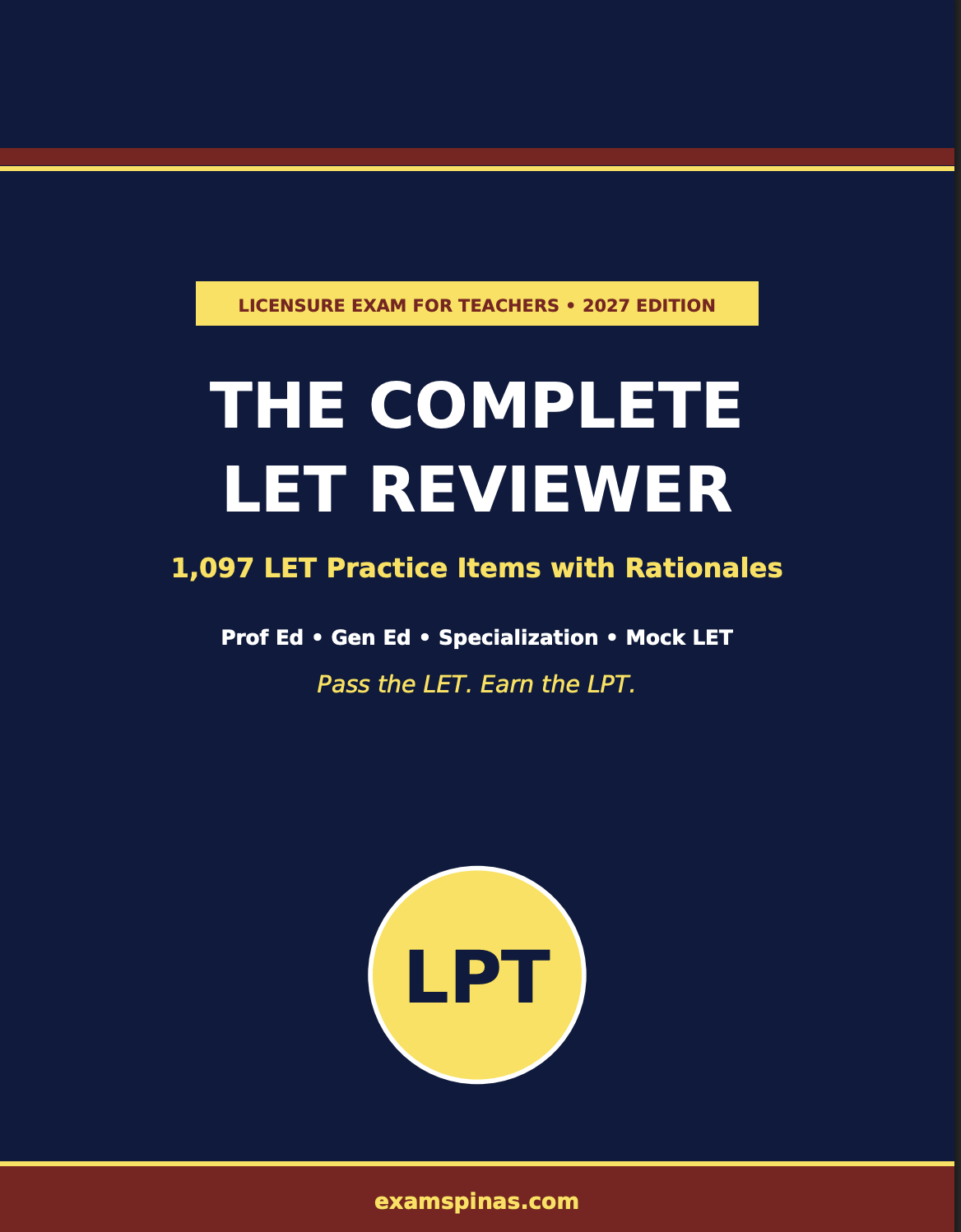
Pumasa sa LET March 2027 — get the complete reviewer
1,097 items with rationales · 40-item timed Mock LET · 16-week study plan · Prof Ed cheat sheet. Aligned with the DepEd MATATAG Curriculum. Digital PDF soft copy emailed after payment — no hard copy, no shipping.
Digital PDF Soft Copy · GCash · Instant Email · No hard copy / shipping
Kung magiging guro ka, ito ang huling hurdle bago ka magkaroon ng “LPT” sa likod ng pangalan mo. This is the most complete March 2027 LET (Licensure Examination for Teachers) prep guide — official schedule, requirements, exam structure for both Elementary and Secondary tracks, subject coverage, passing rate history, a 16-week study plan, and the full career path after you become a Licensed Professional Teacher (LPT). Whether you’re a fresh Education graduate, a repeater, or a career-shifter with a Certificate in Professional Education (CPE), this is your reference.
LET March 2027 Schedule (Official PRC Dates)
The Board for Professional Teachers holds the LET (also known as BLEPT — Board Licensure Examination for Professional Teachers) twice a year, typically in March and September. For the March 2027 batch:
- March 2027 LET: March 28, 2027 (Sunday)
- Application deadline: Around late January to early February 2027 (approximately 45–50 days before exam)
- Application venue: PRC LERIS online portal (prc.gov.ph/leris)
- Examination centers: Manila, Baguio, Cebu, Davao, Iloilo, Legaspi, Lucena, Zamboanga, Cagayan de Oro, Tuguegarao, Pagadian, Tacloban, Puerto Princesa, and 30+ other PRC-designated centers
Always cross-check the official date on the PRC Calendar 2027 since PRC occasionally adjusts by a week for holidays or logistics.
LET Requirements 2027
- Original and photocopy of Transcript of Records with “For Board Examination Purposes” annotation and Special Order (SO) number (waived for CHED-recognized programs)
- Original and photocopy of PSA Birth Certificate
- PSA Marriage Certificate (for married female applicants only)
- NBI Clearance (valid, within 6 months)
- Two passport-size ID photos, white background, with complete name tag
- Community Tax Certificate (Cedula)
- Payment: PHP 900 (subject to change — confirm on LERIS portal)
Degree eligibility: You must be a graduate of a Bachelor’s degree in Elementary Education (BEEd), Secondary Education (BSEd), Special Education (SPED), Technology and Livelihood Education (BTLE/TLE), Physical Education (BPEd), or Early Childhood Education (BECEd) — OR a graduate of any degree with 18 units of professional education (Certificate in Professional Education / CPE / Teaching Certificate Program).
LET Structure: Elementary vs. Secondary
The LET has two tracks and the subjects differ:
Elementary LET (BEEd graduates and CPE holders teaching K–6)
- General Education (20%) — English, Filipino, Mathematics, Science, Social Studies
- Professional Education (40%) — Child and Adolescent Development, Facilitating Learning, Social Dimensions of Education, Principles of Teaching, Assessment of Learning, Curriculum Development, Educational Technology, School Culture & Organizational Leadership
- Specialization / Content (40%) — Content Area subjects for elementary teachers
Secondary LET (BSEd graduates and CPE holders teaching Grades 7–12)
- General Education (20%)
- Professional Education (40%)
- Specialization (40%) — Choose ONE major:
- English
- Filipino
- Mathematics
- Biological Science / Physical Science / General Science
- Araling Panlipunan / Social Studies
- Values Education
- MAPEH (Music, Arts, Physical Education, Health)
- TLE (Technology and Livelihood Education)
- Islamic Studies
- Culture and Arts Education
- Special Education (SpEd)
- Early Childhood Education
LET Passing Score
To pass the LET and be conferred as a Licensed Professional Teacher (LPT), you need:
- 75% or higher general weighted average, AND
- No grade below 50% in any subject area
LET Passing Rate History (National)
The LET has historically been one of the tougher board exams by passing rate — not because the content is uniquely difficult, but because of the sheer volume of takers (100,000+ per batch, mostly from private teacher-education institutions).
- March 2024 LET: Elementary ~35%, Secondary ~34%
- September 2024 LET: Elementary ~30%, Secondary ~33%
- March 2025 LET: Elementary ~36%, Secondary ~32%
- Top-performing schools: Consistently push 70–100% passing rates (PNU, UP, DLSU, ADMU School of Education, and select regional state universities)
16-Week LET Study Plan (Battle-Tested)
Assumes you’re 4 months out and can study 3–4 hours weekdays + 6–8 hours weekends.
- Weeks 1–2: General Education — English (grammar, comprehension, structure) and Filipino (balarila, panitikan)
- Weeks 3–4: General Education — Mathematics (arithmetic, algebra, geometry) and Science (biology, chemistry, physics, earth science)
- Week 5: General Education — Social Studies (Philippine history, geography, current events, ASEAN)
- Weeks 6–7: Professional Education — Child & Adolescent Development, Facilitating Learning, Educational Psychology
- Weeks 8–9: Professional Education — Principles of Teaching, Curriculum Development, Educational Technology
- Week 10: Professional Education — Assessment of Learning (formative, summative, authentic), Social Dimensions of Education
- Weeks 11–13: Specialization / Content Area (your major or your grade level content)
- Week 14: Full mock LET (both Prof Ed and Gen Ed under exam conditions)
- Week 15: Review weakest 3 topics, second full mock exam
- Week 16: Light review, rest, and mental prep. Rest fully 2 days before exam day.
Bookmark the LET 2027 Interactive Sample Exam for weekly practice — 20 items across the 4 subtests with instant scoring.
Best LET Review Centers 2027
- Carl Balita Review Center (CBRC) — nationwide, most popular
- Lorimar Review Center — Metro Manila, provinces
- PRIME Review Center — Manila, Cebu, Davao
- Rex Book Store Review — self-study materials + online
- Inteligrace Review Center — strong Cebu/Visayas presence
- Reyes Review Center — Cavite/Batangas
- Online-only review platforms: LET Made Easy, LET Reviewer PH, Teacher’s Corner PH (Facebook groups + YouTube)
Full 4-month review packages cost PHP 8,000–18,000. Weekend-only or online reviews run PHP 3,500–7,000.
Common Mistakes LET Takers Make
- Skipping Gen Ed because “alam ko na yan.” Gen Ed is 20% of your grade but it’s where most passers lose 5–10 points from careless comprehension errors.
- Studying only one book per subject. LET items are drawn from a rotating pool — use multiple reviewers to see the same concept phrased 3 different ways.
- Cramming Professional Education. Prof Ed (40%) is scenario-heavy. You need to build reasoning, not memorize definitions.
- Ignoring K to 12 updates. The DepEd MATATAG Curriculum (rolled out 2024–2027) is now embedded in Prof Ed items. Old reviewers won’t cover it.
- Not doing full-length mocks. LET is a 2-day, 4-part endurance test. Your brain will not perform on day-of if you’ve only done 30-item practice sets.
- Choosing the wrong specialization. Some passers switch majors midway. Lock your specialization by Week 3 and don’t revisit.
Career After Passing LET (LPT Career Paths)
Once you pass LET, you receive your LPT designation and can pursue:
- DepEd Teacher I (SG 11): PHP 27,000/month starting, with automatic step increments every 3 years
- Private school teacher: PHP 18,000–35,000 (budget/mid-tier), PHP 35,000–80,000 (elite/international)
- SUC / Private college instructor: PHP 25,000–60,000 depending on rank
- DepEd Master Teacher: After 3+ years and additional units, up to PHP 58,394/month
- Principal / School Head: Up to PHP 76,359/month (SG 23)
- Overseas teacher: USA (PHP 200,000–350,000), UK (PHP 180,000–280,000), UAE (PHP 130,000–220,000 tax-free), Vietnam/China ESL (PHP 100,000–180,000)
Full salary breakdown across DepEd, private, college, and overseas is in the 2027 Teacher Salary Guide.
LET vs. Other Board Exams
The LET is a knowledge-heavy but not-technically-demanding exam — passing is a function of study consistency, not raw intelligence. Compared to other 2027 board exams:
- vs. CELE (Criminologist Licensure Exam): Similar passing rate (~30–35%). LET is more pedagogy-oriented, CELE is more law-oriented. See the CELE 2027 guide for comparison.
- vs. CPALE: CPALE is dramatically harder — typically 15–30% passing rate on 7 grueling subjects. See the CPALE May 2027 guide.
- vs. NLE (Nursing): NLE has higher passing rate (~65%) but larger volume of clinical content.
- vs. Engineering boards: CE/EE/ChE/ECE are far more technically demanding (see the hardest courses ranking).
Exam-Day Checklist
- Notice of Admission (NOA) printout + 1 valid government-issued ID
- 2 black ballpoint pens (Panda or Faber-Castell — PRC doesn’t accept gel or erasable)
- Long brown envelope (some centers require it)
- Regular watch (no smartwatch, no phone allowed inside testing room)
- Water and light snacks for the break
- Cash for parking, tricycle, food (no card readers near most PRC centers on exam day)
- Face mask (still required in most PRC centers as of 2027 protocols)
Final Tips for LET March 2027
File your LERIS application at least 2 weeks before the deadline — the portal jams badly in the final week and biometrics slots in NCR sell out. Do a dry run of your commute the weekend before exam day. If you’re taking Elementary LET, brush up on your Mathematics and Science — those two lose more points for Elementary takers than any other subject. If you’re taking Secondary LET, over-prepare your specialization — a strong 40% in your major can carry a weak 20% in Gen Ed.
Practice with the LET Interactive Sample Exam weekly. Keep the PRC Calendar 2027 open for schedule updates. And when the results come out, we’ll be here with the passers list and analysis.
Sa lahat ng future LPT: kayang-kaya ’yan. Ang pagtuturo ay bokasyon, at ang paglaban para sa lisensya ay unang malaking hakbang. See you in the passing list.