

📢 CLE EXAM ALERT: The next Criminologist Licensure Examination (CLE) in the Philippines is scheduled for February 4, 5, & 6, 2026. Personal Identification (Dactyloscopy) is a core component of the Forensic Science (Criminalistics) area, which carries a 15% to 20% weight in your total board rating.
In the Philippines, we follow the Galton-Henry System of Classification. While there are three general “families” of patterns, the PRC Board of Criminology expects you to master the eight basic patterns used in technical fingerprint filing.
1. The Arch Family (5% of all prints)
Arches are the simplest patterns. They generally have no core and no delta.
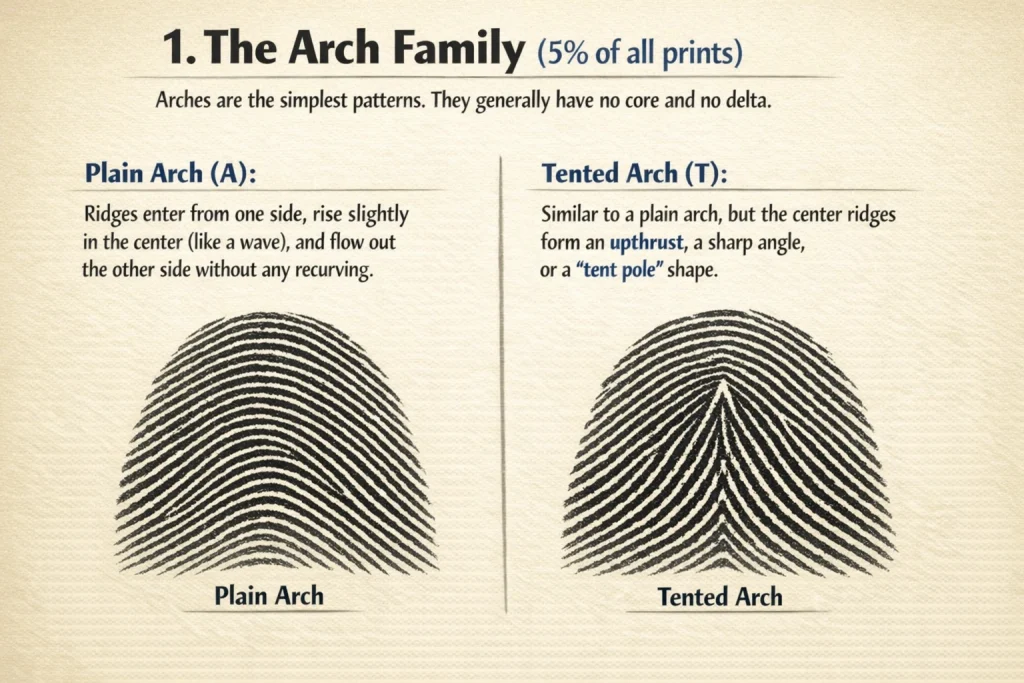
- Plain Arch (A): Ridges enter from one side, rise slightly in the center (like a wave), and flow out the other side without any recurving.
- Tented Arch (T): Similar to a plain arch, but the center ridges form an upthrust, a sharp angle, or a “tent pole” shape.
2. The Loop Family (60% of all prints)
Loops are the most common patterns. To qualify as a loop, a pattern must have one delta, one core, and at least one ridge count.
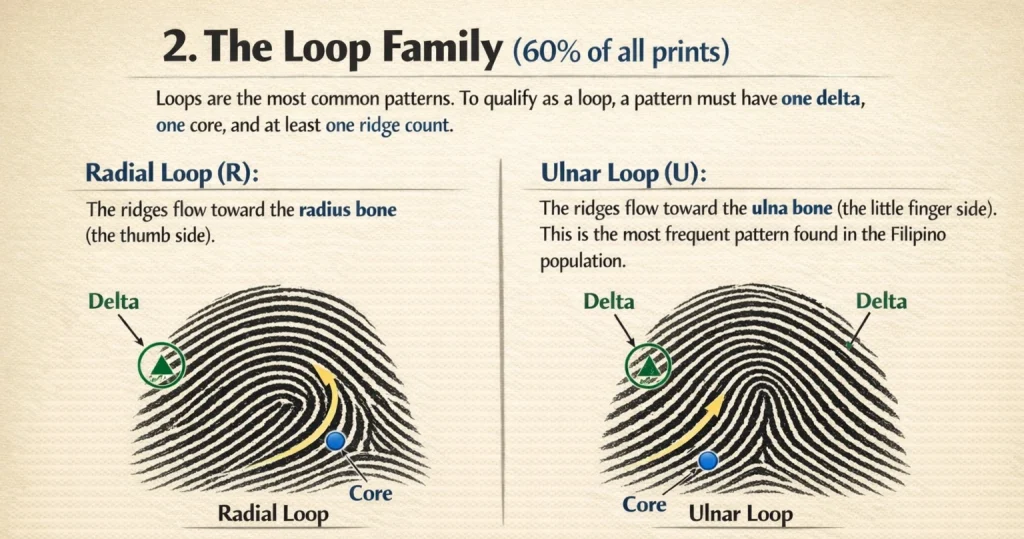
- Radial Loop (R): The ridges flow toward the radius bone (the thumb side).
- Ulnar Loop (U): The ridges flow toward the ulna bone (the little finger side). This is the most frequent pattern found in the Filipino population.
CLE Board Hack: You must know which hand the print came from to name it. On the Right Hand, a loop flowing toward the thumb (left) is Radial. On the Left Hand, a loop flowing toward the thumb (right) is Radial.
3. The Whorl Family (35% of all prints)
Whorls are complex patterns that always have at least two deltas.
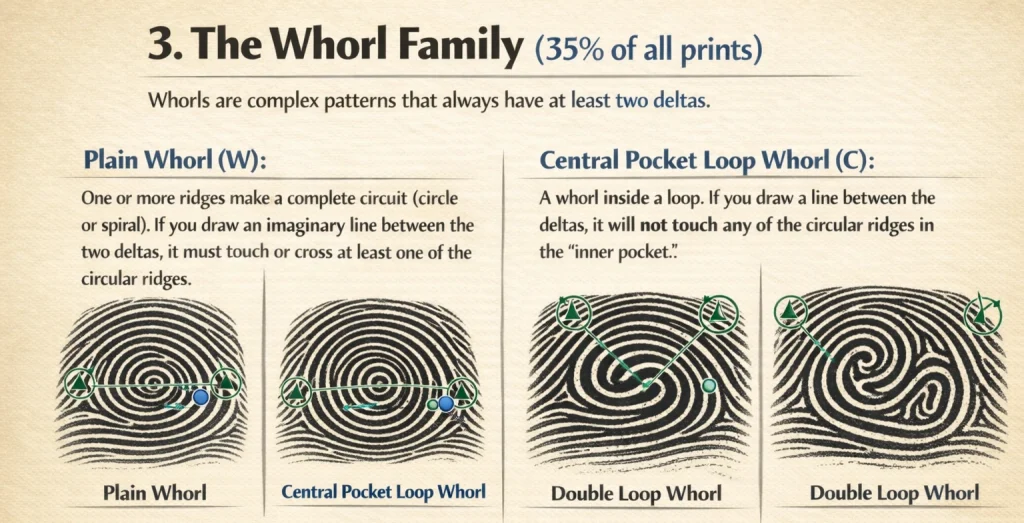
- Plain Whorl (W): One or more ridges make a complete circuit (circle or spiral). If you draw an imaginary line between the two deltas, it must touch or cross at least one of the circular ridges.
- Central Pocket Loop Whorl (C): A whorl inside a loop. If you draw a line between the deltas, it will not touch any of the circular ridges in the “inner pocket.”
- Double Loop Whorl (D): Consists of two separate loop formations with two separate shoulders and two deltas. It looks like an “S” or a “twinned loop.”
- Accidental Whorl (X): A combination of two different patterns (e.g., a loop and a whorl) or a pattern that doesn’t fit any other definition.
PRC Classification Cheat Sheet

The Road to “R.Crim”
Mastering these fingerprint patterns is more than just an exam requirement; it is your first step toward becoming a true expert in the field of Forensic Science. In the Henry System, these symbols are the foundation for the Secondary Classification (Capital Letter Group). A single misidentification—like mistaking a Tented Arch for a Loop—can derail your entire classification formula and cost you vital points in the Forensic Science subject. As you prepare for the February 2026 CLE, stay disciplined in your practice. Every ridge you trace and every delta you identify brings you closer to that license and the honor of serving the public as a Registered Criminologist in the Philippines.